Native American Women in Aeronautics
November is Native American Heritage Month. On this site we have honored many indigenous women who made a difference in their communities and in society. Many Native American women played an important role in shaping aviation. Their role continues to inspire other minorities in aviation to this day. Some were pioneers and some were innovators. This week we share the stories of two women who were firsts in Aviation history – Eula Pearl Carter Scott – youngest solo – and Bessie Coleman – first international pilot’s license.
Eula Pearl Carter Scott (Chickasaw, 1915-2005)

Eula was born in Marlow, Oklahoma to George and Lucy Carter on December 9, 1915. George was white but Lucy was an enrollee of the Chickasaw nation and she was also half Choctaw. George had built up his business and was fairly well off. He was able to buy Eula a sports car and an airplane – a Curtiss Robin. Eula was feisty and adventurous. She learned to drive when she was 12 years old. She met Wiley Post who gave her flying lessons. She soloed on September 12, 1929, at age 13. She was the youngest Oklahoman at that time to accomplish that feat.

She became a stunt pilot. She loved flying but gave it up as a career in exchange for marriage and a family. She married William Lewis “Scotty” Scott on February 5, 1931. They raised three children. Sadly, her marriage ended by 1962 when she was divorced and destitute. She started a new career with the Chickasaw Nation in 1972 as one of the tribe’s community health representatives. In 1983 she was the first woman to be elected to the Chickasaw Nation Tribal Legislature.

During Eula’s three terms with the Legislature the tribe’s services and operations grew enormously. Eula also held memberships in the Marlow Chamber of Commerce, VFW Auxiliary, OX5 Aviation Pioneers, and the United Methodist Church.
Eula has been inducted into the Oklahoma Aviation and Space Hall of Fame; Chickasaw Nation Hall of Fame; International Women’s Air and Space Museum Hall of fame, and she was a charter member of the National Museum of the American Indian. The Pearl Carter Scott Aviation Scholarship was established by the Chickasaw nation in her honor.
The Texas University in Dallas has records of her achievements in aviation. Eula is also listed in Personalities of the South (1978-1979 edition) and Outstanding Women of America (1989-1990). In 1995 a celebration was held to commemorate Wylie Post’s trip around the world. Eual was the guest of honor and homecoming queen.
Eula died in 2005, age 89 in Oklahoma City. She was buried in the Marlow Cemetery near her parents.
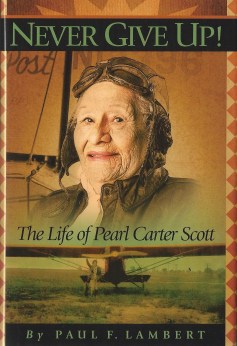
The Chickasaw Nation made a production of her life based on her biography by Dr. Paul Lambert – “Never Give Up! The Life of Pearl Carter Scott”
You can view the trailer for the movie at: https://www.chickasaw.tv/videos/never-give-up-the-life-of-pearl-carter-scott
The movie is at the Chickasaw site: https://www.youtube.com/watch?v=vWU4d0ZWxBo
Bessie Coleman (Cherokee or Choctaw, 1892-1926).

Bessie was born in Waxahachie, Texas in 1892. Her mother was African American and her father was African and Native American, probably Cherokee or Choctaw. Three of his grandparents were Native American. Her father was from Indian Territory. Bessie was one of thirteen children. Her parents were both illiterate.
Born in a poor black community in Atlanta, Texas, Bessie Coleman was not encouraged to follow her dreams. At the time, colored[1] children were not expected to finish school, let alone have the ambition to fly. But nothing could stop Bessie. She worked hard and became the first woman of color to obtain an international flying license. She would go on to become famous nationally for her feats in an airplane.
Bessie had to work to have the money to go to school. When her funds ran out she moved to Chicago to join her brothers in 1915. Her brother fought in WWI and returned home with stories of French female pilots. Bessie was intrigued and tried to enroll in pilot school in the U.S. No one would take a black woman as a student.
She saved her money and took French classes. With the help of Robert Abbott, publisher of the most famous African American newspaper in the United States, Bessie went to France. She was accepted at one of the country’s top flight schools. Though she was the only black woman in her class, she was determined to succeed.
Bessie knew that flying was dangerous. She saw planes crash, but that didn’t stop her. On June 15, 1921, Bessie received her international pilot’s license. She flew in air shows all over Europe. Then Bessie returned to the United States.
She was sure she could find work as a pilot with her prestigious license but few people were willing to hire black females. Bessie went back to Europe for more training. She learned how to do stunt flying and daredevil feats that would become known as ‘barnstorming’. She became famous for her aerial maneuvers – multiple loops, spins, barrel rolls and dives across the sky. By the time Bessie returned to the United States in 1922 she was quite famous.
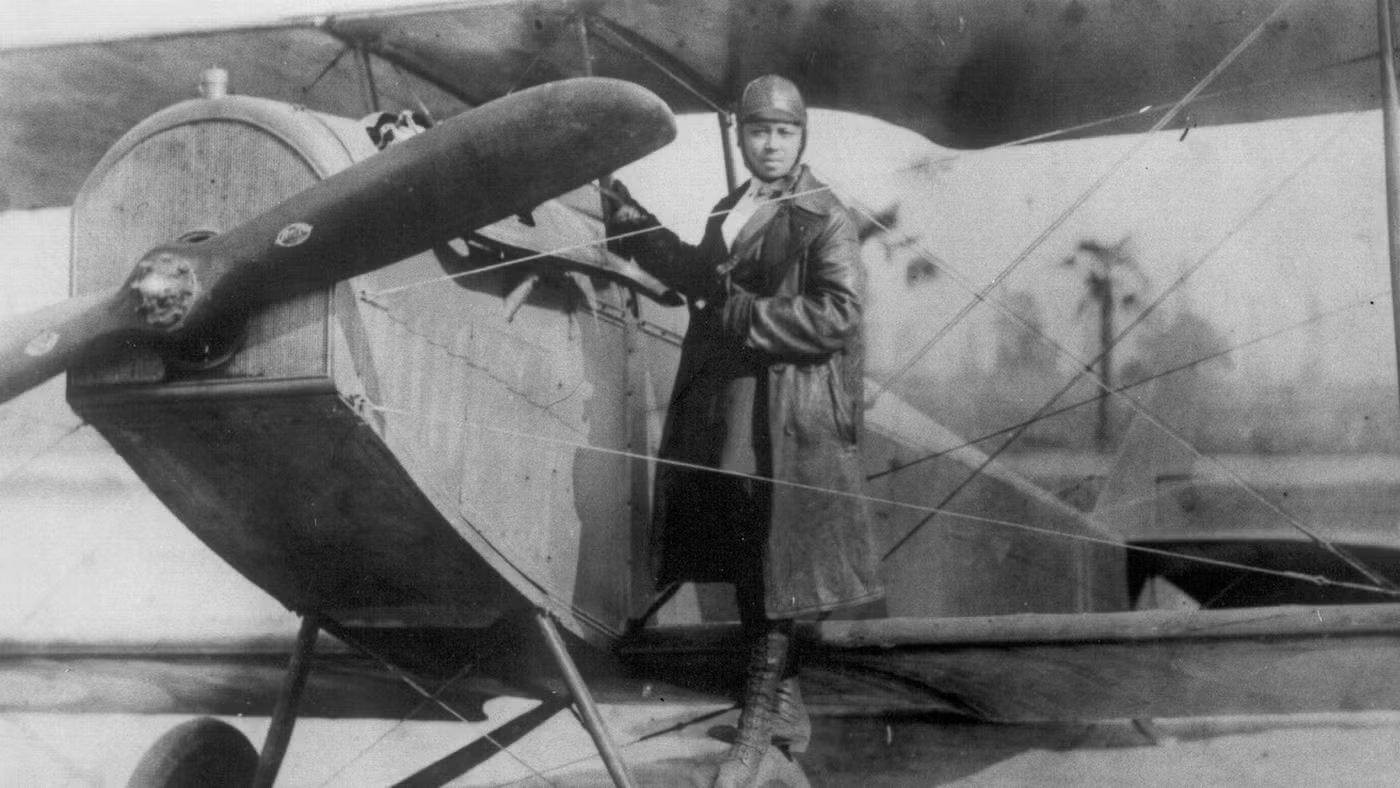
Bessie had her first air show in America on Labor Day, 1922. The following year she was hurt badly in a crash. The indomitable “Queen Bess” was flying again three months later. Also nicknamed ‘Brave Bess’, she continued to cause a sensation with her flying for the next five years.
Bessie wanted to do more than just amaze people with her flying ability. She wanted her life to be an example to the world of what women of color could do. She said that blacks should not have to experience the difficulties that she had faced, so she decided to open a flying school and teach other black women to fly. Bessie traveled around the country lecturing audiences in churches, theaters and schools about flying. She showed films of her work to encourage colored people to follow their dreams.
Using her popularity as leverage, Bessie refused to appear in places where there was segregation. She insisted for example, that white and colored be allowed to use the same entrances to the shows. She insisted that the show promoters treat everyone the same. Bessie also wanted to open a flight school for colored people.
Bessie’s story ended tragically and much too soon. In 1926, only 34 years of age, Bessie and another pilot, William D. Wills flew to Orlando, Florida to attend an air show. Williams lost control of the plane when a loose wrench got stuck in the engine and the plane flipped over. Bessie had unbuckled her belt so she could scout the area better and so she fell to her death from 3500 feet in the air. Wills was also killed as the plane crashed.
Over 10,000 people came to pay their respects as Bessie’s funeral in Chicago. Black pilots from the Chicago area instituted an annual fly over of her grave.
In 1929 William J. Powell founded the Bessie Coleman Aero Club. In 1977 the Bessie Coleman Aviators Club was founded. Bessie is remembered as a woman who persevered against great odds to fulfill her dream. She is a great role model for young African Americans and Native Americans, especially girls.
You can see some wonderful pictures of Bessie on the following YouTube sites:
Bessie Coleman on youtube.com
Bessie Coleman – An American Hero (narration not the best – slow, but many great pictures)
The YouTube site below has some video of that period of time showing some aerial stunts:
Bessie Coleman – Smithsonian Channel VIDEO – “The First Female African American Pilot”
A great little book, written for young readers is:
Bessie Coleman: Trailblazing Pilot, from Scholastic, Inc., Rookie Biographies Series, 2016. Written by Carol Alexander.
Next time we will look at more courageous Native American barnstormers, pilots, and astronauts.
[1] At the time, black people were referred to as ‘colored’. The term ‘African American’ did not come into being until a few decades later. The word “colored” also included anyone who was non-white.


