Native American Women Pilots
It took a lot of courage to fly an airplane in the day when aviation was new. In spite of the obstacles placed before them for their gender or race, there have been some daring Native American women who have contributed to innovation in flight. Last time we looked at two young women who were the first to get pilot licenses – Eula Pearl Carter Scott, youngest pilot at age 13 and Bessie Coleman, first female to get an international license.
This week we will look at three more indigenous women who braved the skies to follow their dreams – Mary Riddle, Madine Pulaski, and Ola Mildred Rexroat.
Mary Riddle (1902-1981, Clatsop/Quinault)
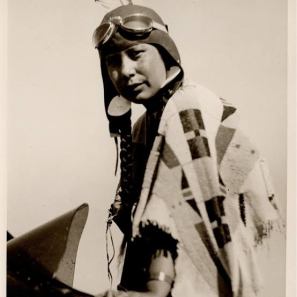
Mary Riddle was born on April 22, 1902, to Albert Riddell and Elizabeth Salikike. Her family was of mixed heritage. Her grandmother Mary was the daughter of a Satsop leader. Her grandfather, John Riddell, made a fortune during the California gold rush. When he died in 1904 he left a portion of it in trust for Mary. When her mother died the children attended Chemawa Indian School in Oregon.
When she turned 18, Mary inherited some money from her grandfather’s estate. She was able to purchase a Ford Sedan and then an Indian Scout motorcycle. She belonged to a club and joined in motorcycle races. Mary was known as a daredevil. She enjoyed swimming, cars, motorcycles and traveling. By the time she started flying in the 1930’s there were already many women flyers. In 1929, for example, the first National Women’s Air Derby Day was held. Later Mary changed the spelling of her last name to Riddle.
But the sky was calling to her. When she was 17 she had witnessed a woman crash an airplane. The public was saying that women could never fly. Mary decided to prove them wrong. She was the second woman to obtain a pilot’s license after Bessie Coleman. She then went on to obtain a commercial license. She also became a member of the famous Ninety-Nines an association of women pilots.

Mary hit the barnstorming circuits appearing as Princess Kus-de-cha. She was trying to live with both of her cultures as best she could. While proud of her Native heritage, she also wanted to make a name for herself in the predominantly white male pilot world. She would sometimes appear in a stereotypical Indian costume with her plane. This seemed to help her overcome the gender and race barriers in American aviation.
She was also entertaining crowds as a parachutist while touring the nation on “The Voice of Washington” the largest tri-motored plane in the world. She served as a stewardess on the plane. She did forty parachute jumps. In 1937 her parachute malfunctioned and she had an accident which almost killed her. The next year she received a back injury and decided to quit parachuting.

During World War II Mary worked as a maintenance advisor and aircraft contributing her bit to the war effort. Mary was an “out front” person and her personality, talent, and exploits helped to pave the way for other women in the twentieth century in aviation.
Mary died on October 25, 1981, in Portland, Oregon. She will be remembered as the one who helped forge a path for new opportunities for women in aviation while demolishing the unreasonable prejudice against them due to erroneous assumptions about limitations of gender and race.
Madine Pulaski (Cherokee, b. 1936) Flight Instructor

Madine was born Etha Madine Waltrip on July 19, 1936, at Eldon on Baron Fork in Adair County, Oklahoma. She later moved to Roseville California to attend Roseville High School, and later Sierra College.
She worked as an air hostess for Trans World Airlines (TWA), becoming a Stewardess in 1957. Then she made a switch and became a pilot, earning her license in 1960. She added multiple ratings including multi-engine and flight instructor. She worked as a flight instructor, charter pilot, cargo pilot, and bush pilot, and also worked as a consultant for Air California.
She competed in long-distance air races helping to establish the Long Beach to La Paz International air race for women. She was a founding member of the Orange County Chapter of the Ninety-Nines. California governor Ronal Reagan appointed her as the first woman to serve on the California Civil Aeronautics Board.
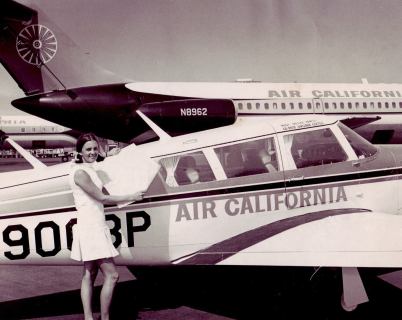
She raced in what were then called powder puff derbies that women pilots still compete in today. In addition to racing, Madine worked as a flight instructor, a bush pilot, flew cargo planes, and chartered flights to bring healthcare providers to impoverished areas in Mexico. She also flew to places such as New Guinea, Australia, and Israel.
After her many years of flight instruction, Madine opened a women’s only health club in Orange County. Other projects included restoring the Tailholt store near Tahlequah, Oklahoma which had once been owned by her great-grandparents, and starting an advertising agency called Favorite Locals.
Madine’s other interests included farming, collecting antiques and quilts, gardening, cooking, painting, writing, and photography. Her family was always very important to her. She married three times; her third husband was Rolly Pulaski. She had several children and stepchildren.
She died in Newport Beach in the hospital while suffering from pancreatic cancer on February 27, 2005. Those attending her funeral were asked not to send flowers but to send their money to the “On Madine’s Wings Foundation”. This organization was created in honor of their pioneering Cherokee Pilot and flight instructor Madine Pulaski.
Here’s a short video done by the “Cherokee Almanac” entitled “Madine Pulaski” done in 2016. It’s so wonderful to see the real footage of a courageous and generous woman.
https://osiyo.tv/watch/almanac/madine-pulaski
Ola Mildred Rexroat (Oglala Sioux, 1917-2017)
Ola was born in Argonia, Kansas in 1917. She lived with her grandmother, who was Oglala Lakota, on the Pine Ridge Reservation in South Dakota. Ola always felt connected to her ancestors. Some were involved in the Wounded Knee Massacre of 1890.
Her father, a white man, was a newspaper printer and editor. He moved the family around quite a bit. Ola moved back to South Dakota in her senior year of high school to attend St. Mary’s Episcopal School for Indian Girls. She attended college but had to take time off to earn money. She did typing and administrative work for the Indian Service, now called the Bureau of Indian affairs. She was able to earn enough money to move to New Mexico where she completed her college degree in art at the University of New Mexico in 1938.
Ola continued to work for the Indian Service on the Navajo Reservation in Arizona. In 1941, she joined her mother and two sisters in Washington, D.C., where they worked for war agencies to support the WWII war effort. Ola was unhappy as a typist. She moved to Texas to work for the U.S. Engineers building airfields in El Paso. That was where she got the desire to fly.
She saved her money and took flying lessons. When she reached the requisite thirty-five hours she applied for the WASP program. In 1944 she received orders to report for training in Sweetwater, Texas. She was ecstatic. She excelled in her training program. After earning her silver wings she was assigned to Eagle Pass Army Air Base on the Texas/Mexico border. She towed targets for gunnery practice. This was dangerous work, but Ola got through.
After the war, Congress disbanded the WASPs. They were just abandoned and did not even get veteran status until 1977. Ola was sad, but she always remembered her WASP years with fondness. She remained close to many other WASPs for the rest of her life. Indigenous service women were not recognized formally until 2009, when President Obama sight a bill awarding the Congressional Gold Medal to former WASPs. In 2016 the Former WASPs gained the right to be buried at Arlington National Cemetery as veterans.

Ola (sometimes called Millie) put her training to good use. She became an air traffic controller. This was a new area for women and while she was working in San Antonio she had to watch as less qualified men were promoted over her. She then moved on to Kirtland Air Force Base in Albuquerque, NM where she worked as a fighter inceptor controller. Then she took a civilian job with the Federal Aviation Administration in Santa Fe. She remained there until she retired in the late 1970’s.
She served two terms as chapter president of the New Mexico branch of he North American Women’s Indian Association. She was able to connect with other Native American veterans. Some 800 Native women served in the U.S. military and thousands more served on the home front in war industries. This gave them a chance for good wages and opportunities.
In 2017, just two months before her 100th birthday, Millie passed away while living at the Veterans Home in Hot Springs, South Dakota. Her son, Forest McDonald, had her ashes interred at Arlington National Cemetery with full military honors.
Despite the double oppression of racism and sexism, Ola became the only Native American woman to be a member of the WASP’s (Women Airforce Service Pilot) during WWII. She will be remembered for her courage and determination to make life better for others.
