“But the midwives feared God, and did not do as the king of Egypt had commanded them, but let the boys live.” (Exodus 1:17)
No history of courageous women would be complete without talking about the two brave midwives, Shiphrah and Puah, who confronted Pharaoh in Egypt when the Israelites were in exile there.
The story is a familiar one. Jacob, or Israel, had twelve sons. One of them, Joseph, was sold into slavery by his jealous brothers. He was living as an exile and a slave in Egypt for many years. God helped him to rise to power during a time of famine. Because there was famine back home in Canaan, too, Joseph’s father and eleven brothers eventually moved to Egypt so that they could have plenty to eat. The amazing details of how God took care of His people during the lifetime of Joseph can be found in the book of Genesis, chapters 37 – 50.
After Joseph died, the Israelites stayed on in Egypt and increased in numbers greatly. After many generations went by, it is estimated that there were about two million Israelites in Egypt. When a new king came to the throne, he was worried about how many of them there were and felt that they were a threat to the security of his nation. So he began to oppress them. We all learned these stories in our Sunday School classes as kids. The Israelites had to make bricks for the cities that the king was building. They were virtually treated like slaves, but it seems the more they were oppressed, the more they multiplied. Their taskmasters laid so many burdens on them that they labored continuously making bricks and working in the fields. Still God blessed them and they increased in number and began to spread out throughout the land.
Now Pharaoh came up with a plan to reduce their numbers. He spoke to two Hebrew midwives, Shiphrah and Puah, and told them to kill the baby boys. He said that the girls could live, but not the boys. It was common practice in Egypt’s history to place the daughters of slaves in Egyptian harems and thus absorb their progeny into Egypt. Pharaoh thought he had a good plan, but he did not reckon with integrity of the midwives.
These brave women did not do as the king commanded them. They let the babies live. They violated his law and then when he questioned them, they gave him an evasive answer. They told him that the Hebrew women were not like Egyptian women. Hebrew women were “vigorous” and gave birth before the midwife could get there.
Some people have said that this answer was just a lie. It is actually possible, however, that in the main what they said was true. It is well known that in cultures where women work in the fields all day, they are able to stop their work, have their baby, bundle it up, and go back to work. We must also remember that at this time God was especially blessing the Israelites and helping them to multiply in number. He would have given the women extra strength to have healthy babies. As an aside, this would also explain why there were only two midwives for several hundred thousand women. The Hebrew women were mainly healthy and just didn’t need many midwives.
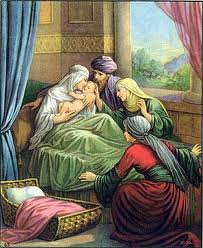 In any event, the midwives put their lives on the line by disobeying Pharaoh. But these women were focused on God and His righteousness and knew that they could have no part in killing babies. As they went about their work, Shiphrah and Puah alerted the Israelites to the wicked plans of Pharaoh. The mothers then hid their children from the soldiers. Because the midwives spared the babies, God blessed them and gave them large households of their own.
Many people wonder how God could bless the midwives when they lied. Isn’t lying a sin? Theologians talk about this “moral dilemma” and take sides on the issue. On one side, some say that lying is always a sin and no one should ever tell a lie no matter what the circumstances. They believe that it is better to take whatever punishment is coming your way, or the way of the person you are trying to protect. These are the moralists.
On the other side are the “situational ethics” scholars, who say that there are degrees of bad things, and we must weigh up the options and choose the lesser of the two evils. It is true that sometimes, as seen in our story for example, a choice must be made. The problem with this view is that the person making the choice has her own set of values and may not know which choice would be the one that God wants. We must be very careful.
It is a dilemma, and many others have faced it – Corrie ten Boom protecting the Jews who were hiding from the Nazis, Rahab protecting the Israelites from the king of Jericho, and Jonathan protecting David from Saul, to name only a few.
All of these seem to have one thing in common, as with the midwives, they were protecting the lives of others. God blessed all of these people for “lying”.
It is also interesting to note however that they did not break the ninth commandment. “What is that?” you ask. “I thought the ninth commandment says, ‘you shall not lie’.” Actually, the ninth commandment says, “You shall not bear false witness against your neighbor.” The purpose of the ninth commandment is justice. To aid Pharaoh, the Nazis, or other wicked rulers in their murderous schemes is assisting evil. That is the opposite of justice. We are not to be accessories to their crimes. And I do not believe that we owe the truth to a man who plans to use it for evil. I must disagree with the moralists who prefer to see evil done rather than to tell a lie. I’m thinking that God must agree, since he blessed Corrie ten Boom by protecting her, Rahab by protecting her and even giving her the privilege of being an ancestress of Jesus, and Jonathan by protecting him from Saul. I am not justifying lying; I am only saying that we must be careful not to correct God on His moral behavior.
Shiphrah and Puah were very special women. I don’t think they knew that they were at the time. They were only midwives doing their job for a hated group of people. But those who put God first, and are faithful to do His will, may be used mightily by Him. Pharaoh expected to be obeyed. He had the power of an absolute ruler, but he was thwarted by two humble, courageous women. Because these women feared God more than the king, the baby Moses was saved. This baby would grow up and lead the people away from Egypt.

