Native American Women Athletes – More Olympians
It is rare for indigenous women to make it to the Olympics. We must admire the ones who persevered against the odds and achieved their dreams. So far we have related the stores of Sharon and Shirley Firth (skiers), Naomi Lang and Tai Babilonia (skaters), Mary Spencer (boxer), and Adrienne Lyle (dressage rider). This week we will share the stories of Tumuaialii (Tumua) Anae (water polo), Mary Killman (swimming), and Abby Roque (ice hockey). We pray that as things get more just in our culture many more Native American women will have more opportunities to make it to the Olympics. Representing Indigenous people on a world stage means representing families and communities. The women in these stories are proud of their heritage and proud to be a role model for Indigenous youth.
Tumuaialii (Tumua) Anae (b. 1988, Native Hawaiian, Olympian)
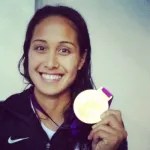
Tumua Anae’s ethnic heritage is Samoan & Native Hawaiian. Her grandfather emigrated from Samoa in the 1920’s. Her name, Tumua is a traditional Samoan name. Tumua attended the University of Southern California as a broadcast journalism major. For the entire four years that she was there she was the goalie for the women’s water polo team.

After her senior year Tumua trained with the National team. Her impressive skills in the water assured her a place on water polo teams for many years. The USC women’s team won the 2010 NCAA Championship. In 2010 she was a finalist for the Peter J. Cutino Award. She went to the Pan American Games where she helped lead the team to a Gold Medal Victory, making several saves.. This won them a berth at the 2012 Olympics. She won gold in the FINA World League Super Final among other victories.

Eight teams competed at the Olympics in 2012. Tumua Anae was Team USA’s back-up goalie to Betsey Armstrong, named the world’s greatest female water polo player. They were the first women’s team to win an Olympic title for Team USA at the 2012 games in London.
Tumua remained involved in sports. Today she is a senior executive for the Utah Jazz in the NBA. She is a member of the USA Water Polo Racial Equity & Reform Task Force.
Mary Killman Bancroft (b. 1991, Potawatomi, Olympian)
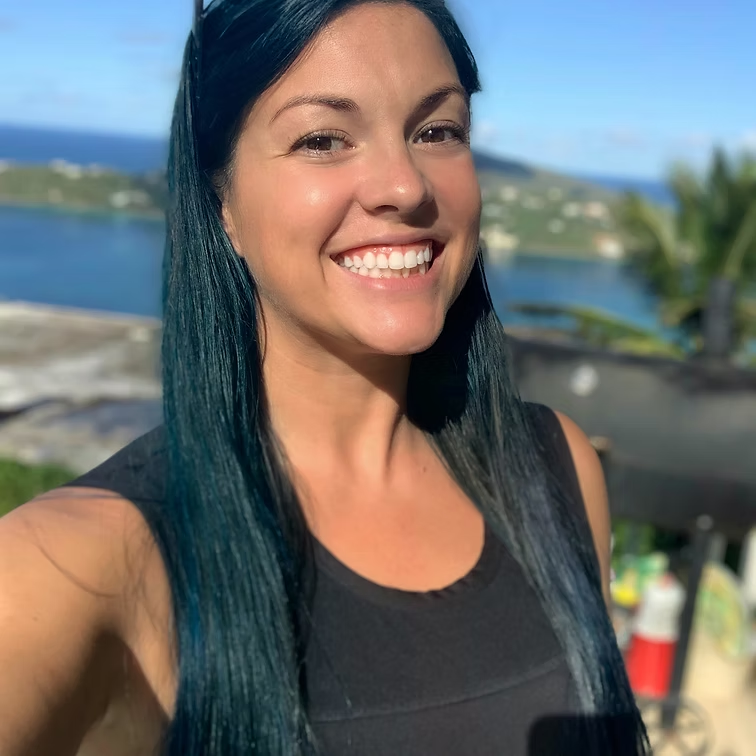
Mary Killman is a member of the Citizen Potawatomi Nation. Her father’s side is Potawatomi and her mother’s side is Choctaw. She is proud of her heritage. Though she was born in Oklahoma she considers Texas her home. As a young girl she was a competitive swimmer. At age 15 she gave it up to concentrate on synchronized swimming. She feels that her heritage gave her a strong will which she needed for the 60 hours/week of intensive training in order to achieve the gracefulness and timing for synchronized swimming.

She won accolades in synchronized swimming with her partner Mariya Korolvea. They won a silver medal at the Pan American Games in Mexico in 2011. They were then invited to the 2012 Olympics in London where they represented the United States of America. She was the youngest athlete to qualify. They placed seventh at the meet.
Mary has been inducted into the USA Synchro Hall of Fame (2020) and holds 4 Athlete of the Year titles. Over her 15 year career she earned 36 medals.
She stayed involved with sports, doing camps and consulting with the National Team. In 2024 Mary was inducted into the North American Indigenous Athletics Hall of Fame.
Abby Roque – (Ojibwe of the Wahnapitae First Nation, b. 1997, Olympian)

Abby was born to Julia and Jim Roque on September 25, 1997, in Sault Ste. Marie, Michigan. She is a member of the Wahnapitae First Nation. Her father is a former NCAA ice hockey coach. This town is just below the Canadian border. Abby has dual citizenship. There is a large Native American population in the town and her culture could be seen and felt everywhere and was celebrated daily. When she went to school the assemblies were started off with a drum circle. Powwows were held at the rink. Abby later said, “It was such a common thing to be surrounded by other Indigenous people there that I didn’t think twice about my own roots. It was a great way to grow up.”[1]
She played on a backyard rink with her family from the time she was 2 years old. She and her sister both learned to skate and Abby loved it. She knew that was what she wanted to do. When she couldn’t find enough girls to play with she played with the boys. She learned how to outwit her opponents. She learned to score and her passing and playmaking skills increased.
Abby moved to Wisconsin after high school. She got a bachelor’s degree in marketing from the University of Wisconsin. She played hockey putting up 170 points in 155 NCAA games for the badgers. She was twice named Offensive Player of the Year. She was named WCHA Rookie of the Year in 2016-17 scoring 28 points in 40 games.
She found things very different as she was the only indigenous person on the team. She said that her teammates were awesome and supportive. She went on to become one of the best players to ever take the ice at Wisconsin. She was the 2020 WCHA Conference Player of the Year, a First Team All-American honoree and the USCHO Player of the Year.

Her accomplishments gave her a chance to make the U.S. women’s national team. In 2022 she made her debut with the team at the Olympics in Beijing. She made two assists and had a goal in the 4-1 win over Finland. Observers said that for a rookie she played like a vet.
She is the first indigenous hockey player to be named to the USA Women’s Hockey Team. She speaks across the country about her experiences. Abby emphasizes what she is doing for communities. She is blazing a trail for young indigenous people to be involved in sports.

Besides speaking, Abby is involved in camps. She loves speaking to young people and encouraging them to reach out for their goals. She seems to have a way with people and acts surprised when she finds out how much influence she has. She did not envision herself in this role but she is good at it. She has helped raise money to make hockey more affordable for families. When she was young she and her family invited people to play in their backyard rink. This experience helped to make her selfless and generous. She later said that she would rather have the game-winning assist than the game-winning goal. This is her way of giving back.
For helping the youth in her community Abby became a Nike N7 ambassador. The Nike N7 Fund was created to help Native American and Indigenous youth achieve their dreams in sports. More than $8 million in grants have been distributed to more than 270 communities since 2009.
She has played internationally and won medals in many series including Gold at the 2015 IIHF Under-18 Women’s World Championships and the 2023 IIHF Women’s World Championship.
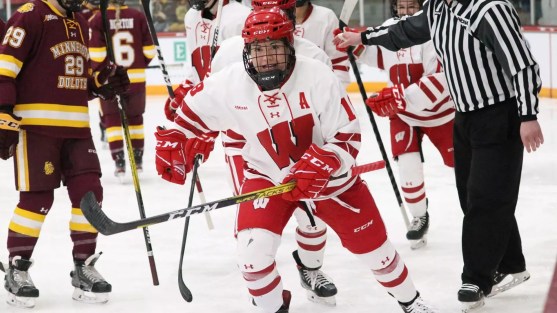
Abby is still playing hockey. She played with Minnesota which gave her an opportunity to play at Madison Square Garden in 2021. She played with the New York Sirens for 3 years and then went to Michigan where she scored the first Michigan goal in the Professional Women’s Hockey League in PWHL history in 2025. She was traded to the Montreal Victoire and is currently looking forward to the 2026-27 season.
[1] Ray Bala, June 22, 2022. US women’s hockey trailblazer Abby Roque gives back to her roots. https://justwomenssports.com/reads/abby-roque-us-womens-hockey-trailblazer/
Native American Women Olympians – Part 2
You do want to (do speaking engagements and camps) because you want to be a visible role model to kids all over. …I’m more than happy to do if it leads more kids to play.
Native American Women Athletes – More Olympians
It is rare for indigenous women to make it to the Olympics. We must admire the ones who persevered against the odds and achieved their dreams. So far we have related the stores of Sharon and Shirley Firth (skiers), Naomi Lang and Tai Babilonia (skaters), Mary Spencer (boxer), and Adrienne Lyle (dressage rider). This week we will share the stories of Tumuaialii (Tumua) Anae (water polo), Mary Killman (swimming), and Abby Roque (ice hockey). We pray that as things get more just in our culture many more Native American women will have more opportunities to make it to the Olympics. Representing Indigenous people on a world stage means representing families and communities. The women in these stories are proud of their heritage and proud to be a role model for Indigenous youth.
Tumuaialii (Tumua) Anae (b. 1988, Native Hawaiian, Olympian)
Tumua Anae’s ethnic heritage is Samoan & Native Hawaiian. Her grandfather emigrated from Samoa in the 1920’s. Her name, Tumua is a traditional Samoan name. Tumua attended the University of Southern California as a broadcast journalism major. For the entire four years that she was there she was the goalie for the women’s water polo team.
After her senior year Tumua trained with the National team. Her impressive skills in the water assured her a place on water polo teams for many years. The USC women’s team won the 2010 NCAA Championship. In 2010 she was a finalist for the Peter J. Cutino Award. She went to the Pan American Games where she helped lead the team to a Gold Medal Victory, making several saves.. This won them a berth at the 2012 Olympics. She won gold in the FINA World League Super Final among other victories.
Eight teams competed at the Olympics in 2012. Tumua Anae was Team USA’s back-up goalie to Betsey Armstrong, named the world’s greatest female water polo player. They were the first women’s team to win an Olympic title for Team USA at the 2012 games in London.
Tumua remained involved in sports. Today she is a senior executive for the Utah Jazz in the NBA. She is a member of the USA Water Polo Racial Equity & Reform Task Force.
Mary Killman Bancroft (b. 1991, Potawatomi, Olympian)
Mary Killman is a member of the Citizen Potawatomi Nation. Her father’s side is Potawatomi and her mother’s side is Choctaw. She is proud of her heritage. Though she was born in Oklahoma she considers Texas her home. As a young girl she was a competitive swimmer. At age 15 she gave it up to concentrate on synchronized swimming. She feels that her heritage gave her a strong will which she needed for the 60 hours/week of intensive training in order to achieve the gracefulness and timing for synchronized swimming.
She won accolades in synchronized swimming with her partner Mariya Korolvea. They won a silver medal at the Pan American Games in Mexico in 2011. They were then invited to the 2012 Olympics in London where they represented the United States of America. She was the youngest athlete to qualify. They placed seventh at the meet.
Mary has been inducted into the USA Synchro Hall of Fame (2020) and holds 4 Athlete of the Year titles. Over her 15 year career she earned 36 medals.
She stayed involved with sports, doing camps and consulting with the National Team. In 2024 Mary was inducted into the North American Indigenous Athletics Hall of Fame.
Abby Roque – (Ojibwe of the Wahnapitae First Nation, b. 1997, Olympian)
Abby was born to Julia and Jim Roque on September 25, 1997, in Sault Ste. Marie, Michigan. She is a member of the Wahnapitae First Nation. Her father is a former NCAA ice hockey coach. This town is just below the Canadian border. Abby has dual citizenship. There is a large Native American population in the town and her culture could be seen and felt everywhere and was celebrated daily. When she went to school the assemblies were started off with a drum circle. Powwows were held at the rink. Abby later said, “It was such a common thing to be surrounded by other Indigenous people there that I didn’t think twice about my own roots. It was a great way to grow up.”[1]
She played on a backyard rink with her family from the time she was 2 years old. She and her sister both learned to skate and Abby loved it. She knew that was what she wanted to do. When she couldn’t find enough girls to play with she played with the boys. She learned how to outwit her opponents. She learned to score and her passing and playmaking skills increased.
Abby moved to Wisconsin after high school. She got a bachelor’s degree in marketing from the University of Wisconsin. She played hockey putting up 170 points in 155 NCAA games for the badgers. She was twice named Offensive Player of the Year. She was named WCHA Rookie of the Year in 2016-17 scoring 28 points in 40 games.
She found things very different as she was the only indigenous person on the team. She said that her teammates were awesome and supportive. She went on to become one of the best players to ever take the ice at Wisconsin. She was the 2020 WCHA Conference Player of the Year, a First Team All-American honoree and the USCHO Player of the Year.
Her accomplishments gave her a chance to make the U.S. women’s national team. In 2022 she made her debut with the team at the Olympics in Beijing. She made two assists and had a goal in the 4-1 win over Finland. Observers said that for a rookie she played like a vet.
She is the first indigenous hockey player to be named to the USA Women’s Hockey Team. She speaks across the country about her experiences. Abby emphasizes what she is doing for communities. She is blazing a trail for young indigenous people to be involved in sports.
Besides speaking, Abby is involved in camps. She loves speaking to young people and encouraging them to reach out for their goals. She seems to have a way with people and acts surprised when she finds out how much influence she has. She did not envision herself in this role but she is good at it. She has helped raise money to make hockey more affordable for families. When she was young she and her family invited people to play in their backyard rink. This experience helped to make her selfless and generous. She later said that she would rather have the game-winning assist than the game-winning goal. This is her way of giving back.
For helping the youth in her community Abby became a Nike N7 ambassador. The Nike N7 Fund was created to help Native American and Indigenous youth achieve their dreams in sports. More than $8 million in grants have been distributed to more than 270 communities since 2009.
She has played internationally and won medals in many series including Gold at the 2015 IIHF Under-18 Women’s World Championships and the 2023 IIHF Women’s World Championship.
Abby is still playing hockey. She played with Minnesota which gave her an opportunity to play at Madison Square Garden in 2021. She played with the New York Sirens for 3 years and then went to Michigan where she scored the first Michigan goal in the Professional Women’s Hockey League in PWHL history in 2025. She was traded to the Montreal Victoire and is currently looking forward to the 2026-27 season.
[1] Ray Bala, June 22, 2022. US women’s hockey trailblazer Abby Roque gives back to her roots. https://justwomenssports.com/reads/abby-roque-us-womens-hockey-trailblazer/
Blog Categories
And why should not women enter the ministry? The mother heart of God will never be known to the world until translated into speech by mother-hearted women.
“The Lord loves righteousness and justice; the earth is full of his unfailing love.”
-Psalm 33:5
People are longing for peace and justice. The women whose stories are in these pages followed the Lord Jesus Christ in his way of compassion and justice for the world. The Gospel message is better presented when Christians match their actions to their words in acts of mercy and love. These women pursued a God of peace and justice who respects all persons, especially the lowly, the weak, the forgotten, the marginalized, and the poor.
Lasting peace comes through faith in the Lord Jesus Christ. True justice comes from God. “Therefore, since we have been justified through faith, we have peace with God through our Lord Jesus Christ,” (Romans 5:1-2). Justified women and men who have the peace, comfort, and assurance of God’s forgiveness have the privilege and the responsibility to advance true justice as they spread the gospel of peace in word and deed. From Shiphrah and Puah to Dorothy Day, the women in these stories are a shining example for Christ’s followers who have been empowered by the Holy Spirit to take the message of hope to a lost world.
“He has shown you, O mortal, what is good. And what does the Lord require of you? To act justly and to love mercy and to walk humbly with hour God.” (Micah 6:8)
.
The women gathered in “Women of Faith and Courage” by Mary Walker are not included merely to inspire for a moment. Their stories carry biblical, historical, and spiritual weight. Each life adds something essential to the wider testimony of faith, reminding readers that Christian history is fuller, more textured, and more instructive when women are remembered with honesty and depth.
That is why the title resonates beyond simple encouragement. It offers recovery rather than novelty, substance rather than sentiment. “Women of Faith and Courage” by Mary Walker is especially well suited for readers who sense that important voices have been minimized and who want to engage stories that restore perspective, memory, and meaning.
.
.
During its two-thousand-year history, the Christian faith has been influenced and passed down by faithful women. The women whose stories are in these pages were martyrs and nuns, mystics and scholars, writers and reformers, preachers and missionaries, abolitionists, and evangelists. These women are examples to us of faith, perseverance, forgiveness, fortitude, and truth and righteousness.
In this book, we will recount the stories of many women from the Early Church to today who sought to follow their callings to serve in God’s kingdom. There are very important reasons for learning about the lives of the female saints beyond giving them the recognition that they deserve for their achievements. We can learn much from the stories of the lives of the women in this book. Women and men are heirs to the promise and have a joint responsibility to practice truth and righteousness and to take the gospel to the lost (Galatians 3:26-29). These dedicated women faced many barriers and confronted many obstacles in their paths as they sought to serve Christ. They did not seek God’s truth and righteousness for themselves but for God’s glory.
“For the word of the LORD is right and true; he is faithful in all he does. The LORD loves righteousness and justice; the earth is full of his unfailing love.” (Psalms 33:4-5).
.
Blog Categories