I thought it would be good to pause here in our journey through the stories of incredible indigenous women. We have been looking at their stories for over a year by category. I have tried to recount the stories in each category chronologically. The time and place that you find yourself in makes a difference to your life. It is true for Native American women as well.
The stories go back to the late 16th century when Europeans first encounter the indigenous people. In this timeline, the history that we know of amazing indigenous women coincides with the history of the European settlers. We do not know of the history before the settlers. Tribal peoples kept their history orally. Almost nothing was written down. Thankfully, there are books coming out now that will recount these stories.
The United States has undergone many changes in the last 5 centuries and native peoples made their contributions to their culture and ours. Let us try and get it in perspective.
The following timeline is to help us put the women into their historical surroundings. You can look back at the stories we’ve recounted and put them in their setting. In the future you can refer to this timeline to understand the culture in which these women found themselves.
15th Century
In 1492 Christopher Columbus reached the East Indies. He referred to the natives there as “Indians”. The name stuck for indigenous peoples even after settlers came to the colonies in America.
16th Century
During this century the Spanish settled in North America in California and Florida. In 1521, Ponce de Leon attempts to start a colony in Florida. Natives attack his group and he is killed. In 1539, Hernando de Soto lands in Florida. This time Native Americans help him explore the southern colonial area. In October 1540, De Soto and the Spanish are attacked by natives in Alabama. Hundreds of indigenous people die in the battle.
Pocahontas, daughter of Chief Powhatan is born c. 1595.
17th Century

In 1607, English Captain John Smith was captured by Pocahontas’ brother. She entreated her father, Chief Powhatan for his life. Later Pocahontas was converted to Christianity. She learned to speak English and was given the name “Rebecca”.
In 1622 the Powhatan Confederacy nearly wipes out Jamestown.
We posted a story from this century on a converted indigenous woman who became a missionary to her people – Kateri Tekakwitha (1656-1680 – Mohawk/Algonquin).[1]
The Pueblo Native Americans in New Mexico threaten the Spaniards in 1680.
18th Century
During this century England, France, The Dutch, and Spain continued to colonize North America. Sometimes they fought over the territory. In 1754 this resulted in the French and Indian War. The Native Americans fought with the French against the English. The French and English continued to fight with each other in the Seven Years’ War. Again, the Native Americans sided with the French. France would control much territory until Napolean sold it to the Americans in the early 1800’s – The Louisiana Purchase.
In this century the Cherokee sought to keep the United States government from controlling their land. They reached an agreement called the Treaty of Hopewell in 1785. In 1791 the Cherokee will sign the Treaty of Holston giving up all of land outside of the borders established.
Sacagawea (Shoshone – c. 1788-1812) is born.[2]
In 1794, the Battle of Fallen Timbers is fought over the Northwest Territory. This last battle fought was won by the United States.
American War for Independence – 1775 to 1783. Some Native Americans fight on both sides.
Look for a post in the near future on Molly Brant (Mohawk) – 1736-1796 – Konwatsi’tsiaienni. Molly fought for the British but we’re doing a post on this remarkably brave woman who followed her convictions.
Also look for the post on Nanye-hi (Nancy Ward) Cherokee, C.1738-1822. (Posted on September 22, 2025) She is still remembered as Beloved Mother. Nanye-hi helped the Americans during the war.
19th Century
A lot happened in the nineteenth century.
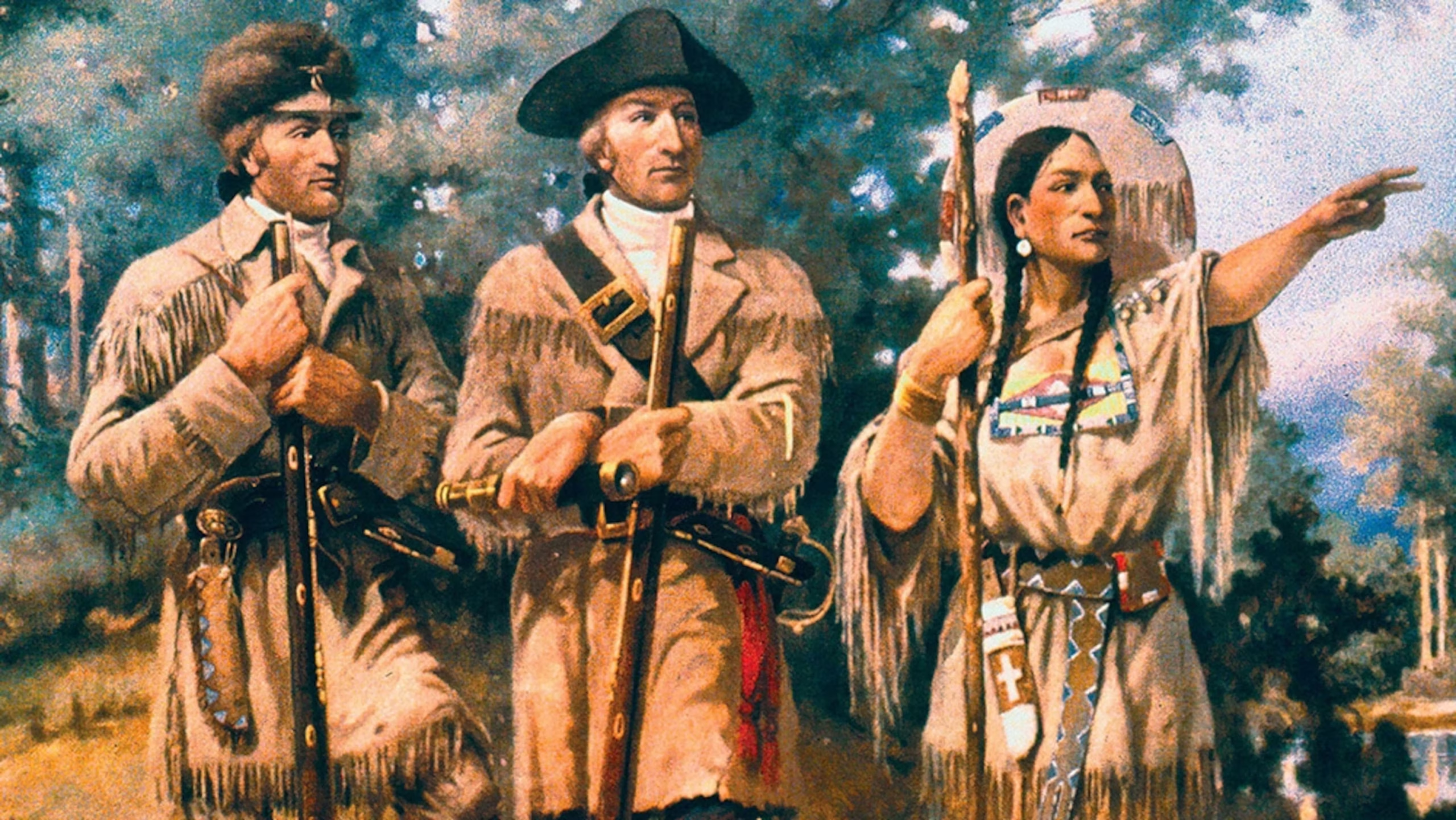
In 1804 and 1805 the Americans sent explorers to search out the newly acquired territory obtained in the Louisiana Purchase. Lewis and Clark take Sacagawea along with them as they travel all the way to the west coast.
In 1811, the U.S. defeats Chief Tecumseh in battle. This Shawnee community near the Tippecanoe and Wabash rives is destroyed.
War of 1812. America declared war on the British. Fighting breaks out between the Americans, the British, the French and Native Americans over territory. American are beginning to expand westward.
In 1814 the Creeks tried to ward off the expansion and battled with U.S. forces. They lost and had to cede more than 20 million acres of land.
President Andrew Jackson signed the Indian Removal Act in 1830. This apparently gave the right to the U.S. government to move Native Americans off of their land to reservation set up for them by the government. In 1836 the Muscogee (Creek) natives leave their land for Oklahoma. More than 3,500 didn’t survive.
In an even more tragic event, in 1838 when the Cherokee weren’t leaving their land fast enough to make the government happy, General Winfield Scott and 7,000 troops march the Cherokee at gunpoint over 1200 miles to Oklahoma. Over 5000 Cherokee would die during this grueling march which has become known as the Trail of Tears.

Important Note: Many of the Cherokee had converted to Christianity. In spite of the fact that they are our Christian brothers and sisters they were treated like animals. Acting like better Christians than the Europeans, the Cherokee people maintained a beautiful testimony.
To make sure the indigenous people stayed on the reservations, the U.S. government passed the Indian Appropriations Act in 1851. Native people could not leave without permission. This was a great hardship on the Native Americans as they left sacred homeground.
In 1877 the Poncas were forced to move to Oklahoma. Chief Standing Bear made the decision to leave the reservation so he could bury his son back on their native ground. He was arrested. Native Americans did not yet have the permission to stand up for themselves in court. Susette La Flesche (Omaha, 1854-1902) traveled with Chief Standing Bear as his interpreter. At this historic trial, Native Americans were finally recognized as humans for the sake of jurisprudence.[3] It would be another half-century before they got the right to vote.
1860-1865 – War Between the States. Native Americans fight on both sides.
During the 1860’ and 1870’s tribes were active in trying to keep their territory. Apaches Cochise (Chiricahua) and Geronimo (Bedonkohe Band) fought in the southwest. There were well-known Apache female warriors during this time including Lozen and Dahteste.[4]
After the war ended the U.S. government renewed its attacks on the tribal peoples. In 1868, General Custer attacks small Indian villages killing women and children. The Sioux and the Americans fight for many years culminating in the Battle of the Little Bighorn in 1876. Custer is defeated and tensions mount between the peoples.
The U.S. decided it would be helpful to assimilate the indigenous peoples and created the Carlisle Indian Industrial School in 1879.
In 1887, President Grover Cleveland signed the Dawes Act. This gave the president the authority to divide up the reservation land into lots and parcel them out as he wished. Since Native Americans do not “own” land this new concept causes irreparable damage that won’t be understood for decades.
In 1890 the Wounded Knee Massacre occurs resulting in the deaths of 150 Native Americans and 25 U.S. Calvary.
20th Century
January 29, 1907 – Charles Curtis became the first Native American U.S. Senator. In 1929, Charles would become the first Native American U.S. vice president serving under President Herbert Hoover.
World War 1 – 1914-1918. The U.S. doesn’t get into the war until 1917. Several Choctaw soldiers are awarded for using their native tongue to transmit secret messages to troops. The Choctaw Telephone Squad gave Allied forces and advantage over the Germans.

June 2, 1924 – Congress passed the Indian Citizenship Act. This granted citizenship to all Native Americans born in the U.S. Some western states, including Arizona, New Mexico and Utah, didn’t grant them the right to vote until the 1940’s and 50’s.
WWII – 1941-1945. Again, during this war several Native American tribes worked as code talkers. The Navajo Nation developed a code that helped the U.S. Marines transmitting messages by radio.
In 1968, the Indian Civil Rights Act was signed into law by President Lyndon B. Johnson. The Native peoples were assured of their benefits included in the Bill of Rights.

November 1969, August 1970. Native Americans occupy Alcatraz Island in an effort to build an Indian school, cultural center and museum. They are hauled off by authorities in 1971. For more on this event which highlighted the Native American peaceful protests for freedom see my post on Wilma Mankiller. Wilma Mankiller (Cherokee, 1945-2010) was also the first female all-tribal chief of the Cherokee.[5]
During the 1970’s there was much activism on the part of Native Americans including camping protests, caravan protests, seizing the Mayflower for a day, occupation of small towns such as Wounded Knee, and marches. For a detailed description see the article prepared by the editors of History.com.[6]
The U.S. government responded with some relief such as the Indian Self-Determination and Education Assistance Act of 1975. This reversed the policy of disbanding tribes, selling their land, relocating them to reservations and urban centers. The act also provided funds to help the Native Americans with their own projects.
Other legislation followed helping the indigenous peoples redress the wrongs. Sensitivity to offensive language led to changing names of places and logos. The “Redskins” was changed to the Commanders. In 2021 the “Indians” became the Guardians.
21st Century

March 15 – Deb Haaland of New Mexico is confirmed as secretary of the interior.
Many other strong and capable Native American women have moved into recognition in the area of sports and politics.
I hope this timeline is useful for you. Please refer back to it while studying any stories you come across of Native American women.
[1] See post on December 5, 2024. https://authormarywalker.com/native-american-women-saints-kateri-tekakwitha/
[2] See post on January 20, 2025. https://authormarywalker.com/native-american-women-explorers-sacagawea/
[3] You can read more about this in the March 12, 2024, post. https://authormarywalker.com/susette-la-flesche-tibbles/
[4] See post on November 19, 2025. https://authormarywalker.com/native-american-women-warriors-lozen-and-dahteste/
[5] See post on November 10, 2025. https://authormarywalker.com/native-american-women-leaders-wilma-mankiller/
[6] History.com article, Native American History Timeline. https://www.history.com/articles/native-american-timeline
Native American History Timeline
I believe much trouble and blood would be saved if we opened our hearts more. Chief Joseph
I thought it would be good to pause here in our journey through the stories of incredible indigenous women. We have been looking at their stories for over a year by category. I have tried to recount the stories in each category chronologically. The time and place that you find yourself in makes a difference to your life. It is true for Native American women as well.
The stories go back to the late 16th century when Europeans first encounter the indigenous people. In this timeline, the history that we know of amazing indigenous women coincides with the history of the European settlers. We do not know of the history before the settlers. Tribal peoples kept their history orally. Almost nothing was written down. Thankfully, there are books coming out now that will recount these stories.
The United States has undergone many changes in the last 5 centuries and native peoples made their contributions to their culture and ours. Let us try and get it in perspective.
The following timeline is to help us put the women into their historical surroundings. You can look back at the stories we’ve recounted and put them in their setting. In the future you can refer to this timeline to understand the culture in which these women found themselves.
15th Century
In 1492 Christopher Columbus reached the East Indies. He referred to the natives there as “Indians”. The name stuck for indigenous peoples even after settlers came to the colonies in America.
16th Century
During this century the Spanish settled in North America in California and Florida. In 1521, Ponce de Leon attempts to start a colony in Florida. Natives attack his group and he is killed. In 1539, Hernando de Soto lands in Florida. This time Native Americans help him explore the southern colonial area. In October 1540, De Soto and the Spanish are attacked by natives in Alabama. Hundreds of indigenous people die in the battle.
Pocahontas, daughter of Chief Powhatan is born c. 1595.
17th Century
In 1607, English Captain John Smith was captured by Pocahontas’ brother. She entreated her father, Chief Powhatan for his life. Later Pocahontas was converted to Christianity. She learned to speak English and was given the name “Rebecca”.
In 1622 the Powhatan Confederacy nearly wipes out Jamestown.
We posted a story from this century on a converted indigenous woman who became a missionary to her people – Kateri Tekakwitha (1656-1680 – Mohawk/Algonquin).[1]
The Pueblo Native Americans in New Mexico threaten the Spaniards in 1680.
18th Century
During this century England, France, The Dutch, and Spain continued to colonize North America. Sometimes they fought over the territory. In 1754 this resulted in the French and Indian War. The Native Americans fought with the French against the English. The French and English continued to fight with each other in the Seven Years’ War. Again, the Native Americans sided with the French. France would control much territory until Napolean sold it to the Americans in the early 1800’s – The Louisiana Purchase.
In this century the Cherokee sought to keep the United States government from controlling their land. They reached an agreement called the Treaty of Hopewell in 1785. In 1791 the Cherokee will sign the Treaty of Holston giving up all of land outside of the borders established.
Sacagawea (Shoshone – c. 1788-1812) is born.[2]
In 1794, the Battle of Fallen Timbers is fought over the Northwest Territory. This last battle fought was won by the United States.
American War for Independence – 1775 to 1783. Some Native Americans fight on both sides.
Look for a post in the near future on Molly Brant (Mohawk) – 1736-1796 – Konwatsi’tsiaienni. Molly fought for the British but we’re doing a post on this remarkably brave woman who followed her convictions.
Also look for the post on Nanye-hi (Nancy Ward) Cherokee, C.1738-1822. (Posted on September 22, 2025) She is still remembered as Beloved Mother. Nanye-hi helped the Americans during the war.
19th Century
A lot happened in the nineteenth century.
In 1804 and 1805 the Americans sent explorers to search out the newly acquired territory obtained in the Louisiana Purchase. Lewis and Clark take Sacagawea along with them as they travel all the way to the west coast.
In 1811, the U.S. defeats Chief Tecumseh in battle. This Shawnee community near the Tippecanoe and Wabash rives is destroyed.
War of 1812. America declared war on the British. Fighting breaks out between the Americans, the British, the French and Native Americans over territory. American are beginning to expand westward.
In 1814 the Creeks tried to ward off the expansion and battled with U.S. forces. They lost and had to cede more than 20 million acres of land.
President Andrew Jackson signed the Indian Removal Act in 1830. This apparently gave the right to the U.S. government to move Native Americans off of their land to reservation set up for them by the government. In 1836 the Muscogee (Creek) natives leave their land for Oklahoma. More than 3,500 didn’t survive.
In an even more tragic event, in 1838 when the Cherokee weren’t leaving their land fast enough to make the government happy, General Winfield Scott and 7,000 troops march the Cherokee at gunpoint over 1200 miles to Oklahoma. Over 5000 Cherokee would die during this grueling march which has become known as the Trail of Tears.
Important Note: Many of the Cherokee had converted to Christianity. In spite of the fact that they are our Christian brothers and sisters they were treated like animals. Acting like better Christians than the Europeans, the Cherokee people maintained a beautiful testimony.
To make sure the indigenous people stayed on the reservations, the U.S. government passed the Indian Appropriations Act in 1851. Native people could not leave without permission. This was a great hardship on the Native Americans as they left sacred homeground.
In 1877 the Poncas were forced to move to Oklahoma. Chief Standing Bear made the decision to leave the reservation so he could bury his son back on their native ground. He was arrested. Native Americans did not yet have the permission to stand up for themselves in court. Susette La Flesche (Omaha, 1854-1902) traveled with Chief Standing Bear as his interpreter. At this historic trial, Native Americans were finally recognized as humans for the sake of jurisprudence.[3] It would be another half-century before they got the right to vote.
1860-1865 – War Between the States. Native Americans fight on both sides.
During the 1860’ and 1870’s tribes were active in trying to keep their territory. Apaches Cochise (Chiricahua) and Geronimo (Bedonkohe Band) fought in the southwest. There were well-known Apache female warriors during this time including Lozen and Dahteste.[4]
After the war ended the U.S. government renewed its attacks on the tribal peoples. In 1868, General Custer attacks small Indian villages killing women and children. The Sioux and the Americans fight for many years culminating in the Battle of the Little Bighorn in 1876. Custer is defeated and tensions mount between the peoples.
The U.S. decided it would be helpful to assimilate the indigenous peoples and created the Carlisle Indian Industrial School in 1879.
In 1887, President Grover Cleveland signed the Dawes Act. This gave the president the authority to divide up the reservation land into lots and parcel them out as he wished. Since Native Americans do not “own” land this new concept causes irreparable damage that won’t be understood for decades.
In 1890 the Wounded Knee Massacre occurs resulting in the deaths of 150 Native Americans and 25 U.S. Calvary.
20th Century
January 29, 1907 – Charles Curtis became the first Native American U.S. Senator. In 1929, Charles would become the first Native American U.S. vice president serving under President Herbert Hoover.
World War 1 – 1914-1918. The U.S. doesn’t get into the war until 1917. Several Choctaw soldiers are awarded for using their native tongue to transmit secret messages to troops. The Choctaw Telephone Squad gave Allied forces and advantage over the Germans.
June 2, 1924 – Congress passed the Indian Citizenship Act. This granted citizenship to all Native Americans born in the U.S. Some western states, including Arizona, New Mexico and Utah, didn’t grant them the right to vote until the 1940’s and 50’s.
WWII – 1941-1945. Again, during this war several Native American tribes worked as code talkers. The Navajo Nation developed a code that helped the U.S. Marines transmitting messages by radio.
In 1968, the Indian Civil Rights Act was signed into law by President Lyndon B. Johnson. The Native peoples were assured of their benefits included in the Bill of Rights.
November 1969, August 1970. Native Americans occupy Alcatraz Island in an effort to build an Indian school, cultural center and museum. They are hauled off by authorities in 1971. For more on this event which highlighted the Native American peaceful protests for freedom see my post on Wilma Mankiller. Wilma Mankiller (Cherokee, 1945-2010) was also the first female all-tribal chief of the Cherokee.[5]
During the 1970’s there was much activism on the part of Native Americans including camping protests, caravan protests, seizing the Mayflower for a day, occupation of small towns such as Wounded Knee, and marches. For a detailed description see the article prepared by the editors of History.com.[6]
The U.S. government responded with some relief such as the Indian Self-Determination and Education Assistance Act of 1975. This reversed the policy of disbanding tribes, selling their land, relocating them to reservations and urban centers. The act also provided funds to help the Native Americans with their own projects.
Other legislation followed helping the indigenous peoples redress the wrongs. Sensitivity to offensive language led to changing names of places and logos. The “Redskins” was changed to the Commanders. In 2021 the “Indians” became the Guardians.
21st Century
March 15 – Deb Haaland of New Mexico is confirmed as secretary of the interior.
Many other strong and capable Native American women have moved into recognition in the area of sports and politics.
I hope this timeline is useful for you. Please refer back to it while studying any stories you come across of Native American women.
[1] See post on December 5, 2024. https://authormarywalker.com/native-american-women-saints-kateri-tekakwitha/
[2] See post on January 20, 2025. https://authormarywalker.com/native-american-women-explorers-sacagawea/
[3] You can read more about this in the March 12, 2024, post. https://authormarywalker.com/susette-la-flesche-tibbles/
[4] See post on November 19, 2025. https://authormarywalker.com/native-american-women-warriors-lozen-and-dahteste/
[5] See post on November 10, 2025. https://authormarywalker.com/native-american-women-leaders-wilma-mankiller/
[6] History.com article, Native American History Timeline. https://www.history.com/articles/native-american-timeline
Blog Categories
She died a successful warrior, doing what she loved.
Blog Categories