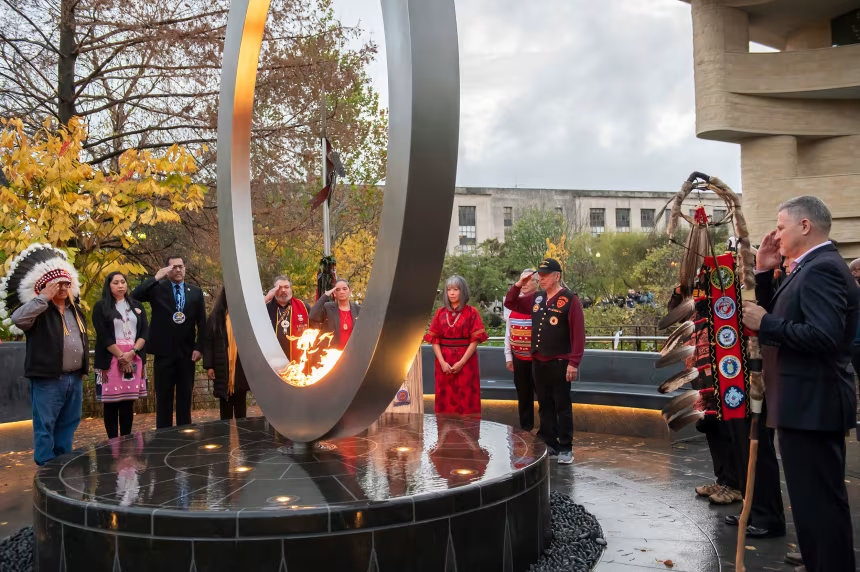
It just so happens that this post is landing on Memorial Day, 2026. We honor the women and men who sacrificed their time and sometimes their lives to protect our country. May God bless all veterans and those in service today.
The Europeans had been engaged in World War One since 1914. The United States did not get involved until 1917. By September 1917 thousands of Native Americans had joined the Red Cross. American Indians were members of the first combat units to reach France. They fought in every engagement until the war ended in 1918. They fought to “demonstrate their patriotism, prove themselves in battle, and defend democracy in Europe.”[1] Many Native American women joined the US armed forces to serve as nurses during World War I.
Native Americans fought even though one third of American Indians remained unrecognized as US citizens. The soldiers hoped the government would respond by extending them citizenship and respecting tribal lands and autonomy. Citizenship was granted in 1924, but it would be many years before the government would grant them autonomy.
Native women served as army nurses in France, several of whom achieved honors for their work. This week we feature two – Cora Elm and Charlotte Edith Anderson.
Cora Elm (Oneida, 1891-1949)
Cora was born to Jane and Nicholas Elm on the Oneida reservation in Wisconsin on February 18, 1891. She was one of eight children and all were needed on the 100-acre farm that her father owned and managed. But Nicholas Elm wanted his children to get a good education so he sent them to boarding schools. Cora managed to get through school while preserving her indigenous heritage. She spoke fluent Oneida as well as English.

She was raised in the Episcopal faith and remained devoted to it all her life. The Episcopal training she received helped her to integrate her faith with her life. She learned the ways of the missionaries who sought to serve others and her life embodied the teachings of Christ.
Cora attended the United States Indian Industrial School in Carlise, Pennsylvania from 1906 to 1913. She excelled in her studies. After graduation she attended The Episcopal Hospital School of Nursing in Philadelphia. She graduated in 1916 and stayed on working as a nurse. She was appointed Supervisor of Wards. Several years later the United States became involved in World War I.
The US Army Nurses Corps had been established in 1901. When the US entered the war there were 403 nurses on active duty. By the end of the war nearly 21,000 Army nurses served overseas. Fourteen of these were Native American women. Cora Elm and Charlotte Edith Anderson were two of them. The preconception among people was that only white women could serve as nurses. Cora and Charlotte helped change that perception.

Cora would later explain her experience during WWI as not easy. She recalled nursing men without legs or arms. The nurses were responsible for medical care for over 9,000 patients. Cora and the other nurses paid a huge psychological toll. It is hard to imagine the things that she saw and we must admire her courage.[2] If you’ve ever watched a movie on WWI with scenes from the trenches you can get an idea of what Cora witnessed. She bravely cared for the wounded in spite of her own feelings.
After the war Cora served as an army nurse in the Baltic States and during the Allies’ intervention in Russia after the Bolshevik Revolution from 1918-1920. She returned to the United States in 1922. She continued to work as a nurse in hospitals including Fort Bavard Hospital in New Mexico and Wood Veterans Hospital in Wisconsin. She served as a supervisor in the tuberculosis wards.
In 1922 Cora married James E. Sinnard. They had one child, James Jr. They eventually divorced. She continued to work in hospitals until her death in 1949. She is buried in the Holy Apostles Church Cemetery in Oneida Wisconsin with a military headstone.
Charlotte Edith Anderson Monture (Mohawk, Six Nations, 1890-1996)
Charlotte was the first Status Aboriginal Canadian woman to train and work as a registered nurse. Because of racial discrimination in Canada, Charlotte had to travel to the United States for her training.
Charlotte Edith Anderson Monture (Kanien’kehá:ka “People of the Chert” or Mohawk) was born on the Six Nations of the Grand River Reserve near Brantford, Ontario. Her parents were Mary Thomas and John Anderson. She was the youngest of eight children. Her Mohawk people called her Emily and later she took the nickname “Andy”.
She lived during the time that Canada had passed the Federal Indian Act which restricted its Status Aboriginal peoples from higher education. Charlotte was interested in a career in the health sciences but was turned down because it was illegal for Native Canadians to get a diploma after elementary school.

Undaunted by the roadblocks, she found a way to continue her education. She attended day school on the reserve and later attended Brantford Collegiate Academy. She was one of a few indigenous women to get a high school diploma. Unable to get into a Canadian nursing school, she looked further afield. She was accepted at the New Rochelle Nursing School in New York. She was one of the first women from the Reserve to leave and pursue a career. She graduated first in her class in 1914. Her granddaughter later said in an interview that her lowest mark was 96. Charlotte continued to live in New York and worked in public health.
When the United States entered the war in 1917 Charlotte volunteered in the local American Red Cross Nursing Service. Her unit merged into the Westchester County Unit B of the American Expeditionary Force. She served in Vittel, France. Charlotte was the only First Nations nurse known to have served during WWI.
In preparation for service, “Andy” and the rest of the 20 nurses in her unit were trained in hygiene and surgical procedures at Fort Slocum on David’s Island in Long Island Sound. They transferred to Ellis Island where they met up with other nurses from the hospital in Buffalo, NY. The unit sailed to Liverpool then to Le Havre. They boarded the train for Vittel arriving March 10.
Vittel had been known as a destination for travelers because of its hot springs and mineral baths. Now the French government had confiscated its famous hotels to use as hospitals. The hotels, villas, and garages in the area housed 1800 patients at a time. A medical facility was opened which treated more than 11,000 patients. The nurses took care of men who were shot or gassed. Some of the nurses visited German POW camps. Like Cora Elm, Charlotte witnessed many ugly atrocities.

Work in the hospitals was tiring and often sad. She could see as many as 60 or more patients a day and possibly helped with the more than 50 operations a day taking place. The nurses and doctors always had the fear of a gas attack in their minds. Like many of the nurses she was sympathetic to the young soldiers. She wrote letters home for them. Later in an interview she recalled weeping at night when one of the soldiers succumbed to his wounds. Charlotte remembered the destroyed buildings, burnt up trees, pieces of shells, and deserted towns.
After the war ended (1919) she returned to her home at the Six Nations Reserve. She married Claybran Monture. The had four children. She continued her work as a nurse and a midwife on the reserve until the mid-1950’s.
In the photo are the surviving Anderson siblings. Edith is the third from the left.

Charlotte died six days short of her 106th birthday in 1996. She was buried in the St. John’s Anglican Cemetery on the six Nations Reserve. She received a military funeral as the last surviving World War I veteran from the Six Nations. Today, a street and park in Brantford are named after her. The First Peoples’ Hall in the Canadian Museum of History has a special exhibit honoring her for her role in WWI.
Cora Elm and (Charlotte) Edith Anderson were groundbreakers for Native American women. Cora’s dedication to duty paved a path for other indigenous women to pursue careers in medicine. Her example also became motivation for indigenous to serve in the armed forces. Charlotte overcame significant barriers to pursue her education in nursing. Her determination and persevering attitude opened doors. She became one of the first females to vote in 1917 when Canada extended the right to vote to women.
Truly, these women deserve our honor and respect.
[1] From: “Why We Serve” – https://americanindian.si.edu/why-we-serve/topics/world-war-1/
[2] You can read more of her account in her story, “Life, Belief, and the War” (1942). Her story and many others are found in the book – Hervert S. Lewis, editor. Oneida Lives: Long-Lost Voices of the Wisconsin Oneidas. (University of Nebraska Press, 2005)
