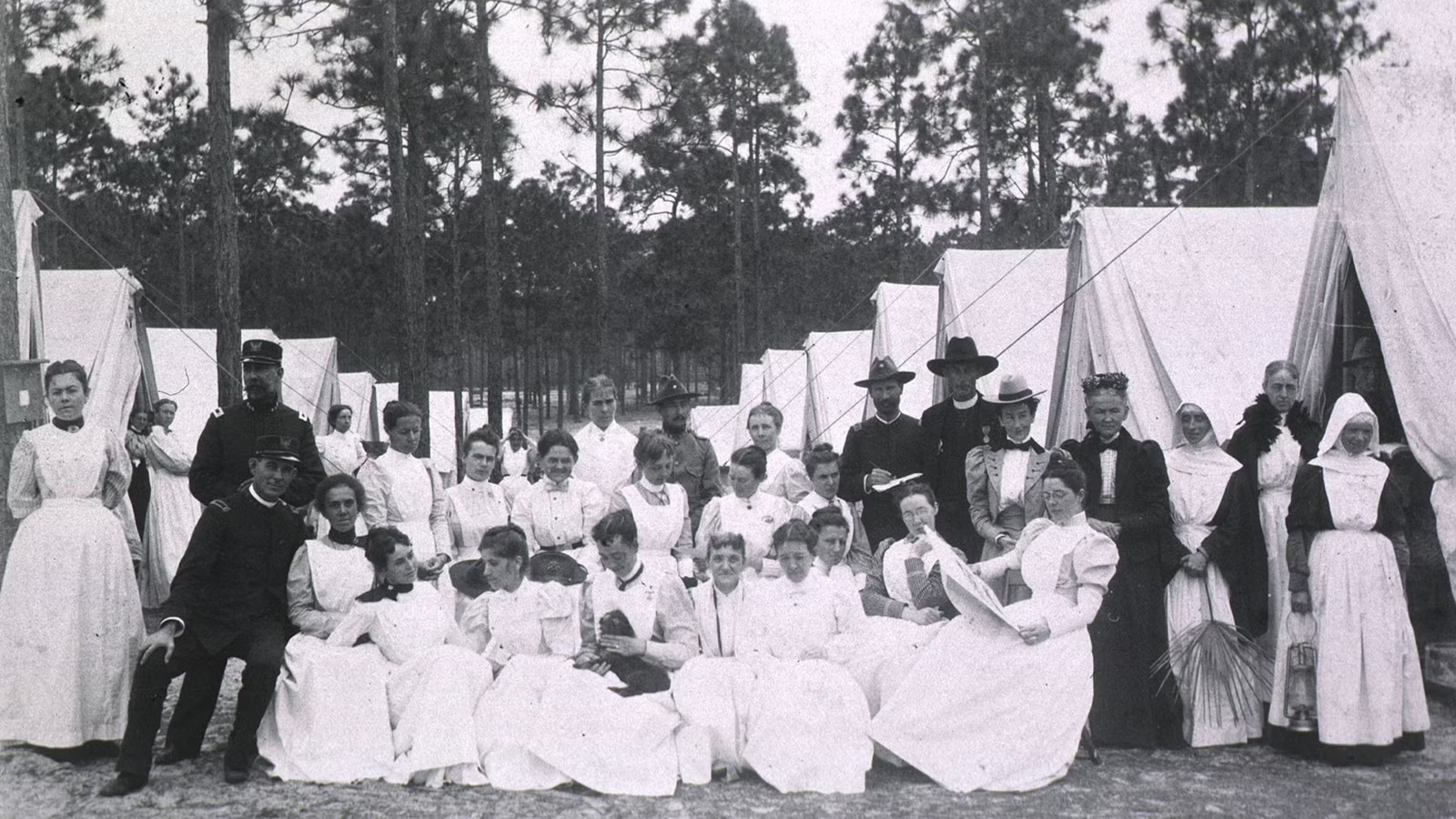
Thinking about joining the armed services is a challenging situation for Native Americans who are also US citizens. Each woman feels the pull of loyalty to her tribe and her country. I respect each individual’s decision when it comes to whether or not to join the United States armed forces to serve in a war. There is a website – “Why We Serve” which honors the Native Americans who have served in the armed forces. They explain the reasons for the faithful service of Indigenous peoples:
Native people have served for the same reasons as anyone else: to demonstrate patriotism or pursue employment, education, or adventure. Many were drafted. Yet tribal warrior traditions, treaty commitment with the United States, and responsibility for defending Native homelands have also inspire the enduring legacy of Indigenous military service.[1]
In the next few weeks, we will relate the stories of courageous Native American women who served in the armed forces in various capacities. This week we will look at the Spanish American War.
Anna Pleets, Josephine Two Bears, Susan Bordeaux, Ella Clarke (all members of the Lakota tribe)
The Spanish American War took place in 1898. The Cubans were seeking independence from Spain and the United States decided to help them. The war only lasted a few months but thousands of soldiers needed medical attention for wounds, inadequate diet, dysentery, typhoid, malaria, and yellow fever. The army hired medical personnel including four Lakota nuns who were trained nurses from North Dakota.
Over 1000 nurses were sent to the camps to care for the wounded. They were trained and endorsed by the training institute. Because of the harsh conditions in the camps, they also needed a physician’s certificate stating that they were well and strong enough for army duty. Government records show that 250 sister nurses from many orders answered the call to serve. You can get more details in a great article by Mercedes Graf.[2]In this post we will feature the Congregation of American Sisters.

The sisters worked under the founder of their order, Father Francis M. Craft (Mohawk). Father Craft had a medical background and he trained the women in nursing. As is traditional in the Catholic Church the women took the names of saints – Josephine Two Bears, age 31 took the name Sister Mary Joseph; Ella Clarke, 28 became Sister Mary Gertrude; Susan Bordeaux, 31 became Sister Mary Anthony; and Anna Pleets became Mother Mary Bridget.
The army contracted with the women for $30/month. They assigned the women to some of the toughest camps because of their Native American heritage. It was believed that indigenous women were immune from disease simply because of their race. Somehow their “Indian blood” made them stronger and able to withstand rugged conditions. The army also thought that the women had experience working in less than immaculate conditions on the reservations. Unfortunately, these prejudices did not save Mother Anthony from succumbing to illness and dying later that year.
The soldiers loved the nurse. The women seemed to be tireless and they always attended the wounded with warm smiles. The men knew that the women were putting their own lives on the line as they nursed them back to health. One Cuban patient later wrote, “We should give our attention to the lady nurses who are in the service. They are the kindest, gentlest and most patient of creatures and deserve a world of credit from the wives and the mothers of the boys in blue, and their names and heroic deeds should be chronicled on the pages of our great, grand and glorious nation’s history.”
The nurses were moved around to five different hospitals in four months. First, at Camp Cuba Libre in Jacksonville, Florida, they worked in two wards that were set aside for patients with measles and mumps. Sister Mary Bridget and Mother Anthony worked the daytime shift and Sisters Mary Joseph and Mary Gertrude took the night shift.
One month later, they were moved to the division hospital in Jacksonville, then to another division hospital in Savannah, Georgia for a short period of time where they waited for orders. Then they were moved to Camp Columbia in Havanna where they served at two different hospitals. The war having ended, the Spanish were leaving the camp while the Americans were moving in. Many Cubans were uneasy about the changes. The nurses helped to put the patients at ease with their attitude of fairness, treating Spanish, Cubans, and Americans equally. The conditions at this camp were primitive. They had to walk ½ mile to the nearest clean water.
This moving around was not good for their health. When they finally returned home, their Personal Data cards showed that they were “not strong” and had “poor health.” They were given the lowest ranking possible – “4”. This is evidence of the incredible devotion that the sisters displayed in their work. Their willingness to move from camp to camp as emergencies arose impressed the men and the administration. No wonder the women had such bad health, but they pushed through because they were committed to helping those in need. They did it out of love and not for honor. They could not have known that years later they would be honored as the first Native American women to serve in the armed forces in the Spanish American war.
By February 1899, the sisters had barely gotten started at their last hospital when the army informed them that their contracts were ended. At the same time, their standing with the Catholic Church was in question. It seems that Father Craft was very outspoken and had caused trouble for himself with the government and the Catholic Church.[3] Father Craft and the nurses decided to continue to serve after their honorable discharge. They traveled about 100 miles to Pinar del Rio Province where they worked as volunteers caring for soldiers and civilians.
The women were welcomed in the community, even joining a local parish choir. Tragically, a few months later, October 15, Mother Mary Anthony succumbed to the pneumonia she had contracted previously in Florida. When Mother Anthony died she was greatly mourned. She was buried in the local cemetery. Father Craft insisted that she be buried with full military honors. Though she was not buried in Arlington Cemetery in Virginia with other fallen soldiers as Father Craft tried to arrange, she was buried with honors at Camp Egbert, Pinar del Rio, Cuba. Father Craft wrote after her death, “She was much beloved by the soldiers whom she had nursed back to health at the sacrifice of her own life and American soldiers mingled their tears and prayers with those of Cubans and Spaniards who loved her for her care of their orphans and sick.” It has been reported that she was the granddaughter of Chief Spotted Tail and the grandniece of Chief Red Cloud.
By December Sisters Bridget (Anna Pleets) and Gertrude (Ella Clarke) decided to leave. They were not only in poor health but were home sick. They believed they could get better care back home. They returned to their reservation and resumed lives as laywomen, taking back their former names.
Anna Pleets married Joe Dubray. She pursued occupation as a midwife. She was given a military funeral and buried in St. Peter’s Cemetery in Fort Yates, North Dakota. Anna held on to the apron given her by dying soldiers for the rest of her life. They had written their names and addresses on it so she could write to their relatives.
Ella Clarke marred Joe Hidgkiss. The last years of her life were spent at the Old Soldiers Home in Hot Springs, South Dakota.
Josephine Two Bears continued to serve in Cuba. She ran an orphanage until 1901 and then returned to her home. She married Joachim Hairychin. Sadly, she died in childbirth in 1909. Further reports state that Josephine was the daughter of Chief Two Bears of Standing Rock.

All four sisters were awarded the silver crosses of the Order of Spanish-American War Nurses. The US House of Representatives had also honored their contributions in February 1899. They were awarded special medals signifying their service in the Spanish American War. They had made their mark as the first known Native American women to serve in the US armed forces. There is a memorial Arlington National Cemetery honoring the nurses in the Spanish-American War. (Pictures below are front and back.)


Sisters Mary Anthony, Mary Joseph, Mary Gertrude, and Mary Bridget did their work lovingly and conscientiously in spite of the racial prejudice. We honor these women who served because they followed in the footsteps of Jesus.
[1] “Why We Serve” – https://americanindian.si.edu/why-we-serve/
[2] Mercedes Graf. Band of Angels: Sister Nurses in the Spanish-American War. 2002.https://www.archives.gov/publications/prologue/2002/fall/band-of-angels-1.html
[3] For more background information go to: “How Four Nuns Became the First Native American Women to Serve in the US Military” – https://www.military.com/daily-news/2023/11/28/how-four-nuns-became-first-native-american-women-serve-us-military.html

One Response
wish you all the best